


The Lodge Cartel, the Corrosion of the Rule of Law, and the Global Media Inquisition
10 November 2026 – A Scathing, Investigative Essay on Law and Politics – by Andreas Manousos
Legal Notice and Disclaimer
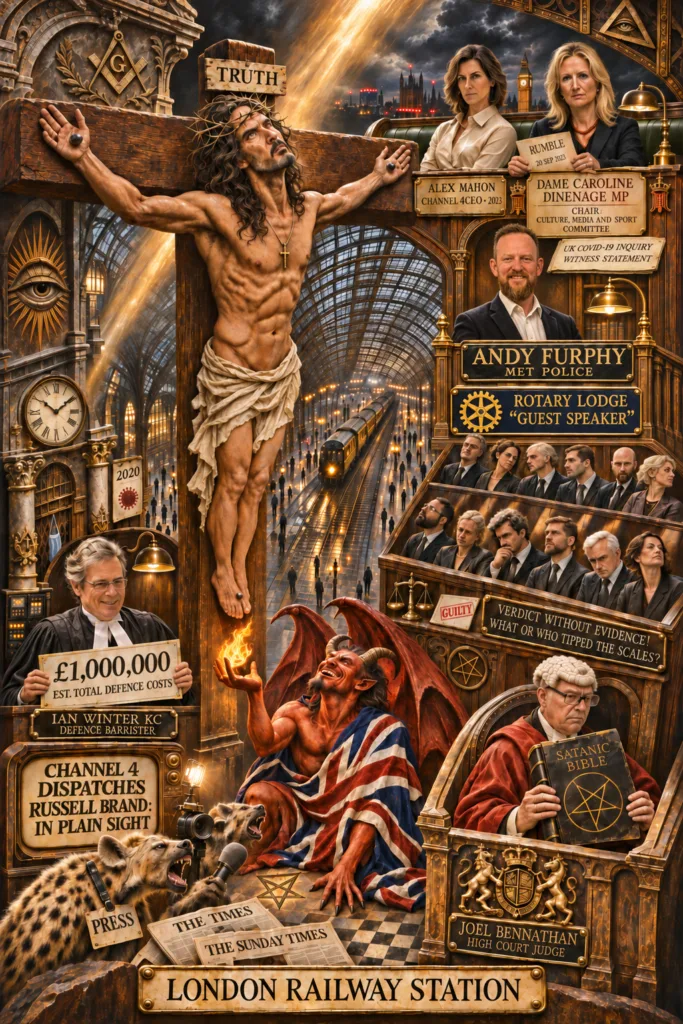
The textual and illustrative content herein reflects solely the personal opinion, interpretation, and subjective appraisal of the author. It is presented as an independent, dissenting contribution to public discourse, exercised under the fundamental protections of freedom of speech and the press. The accompanying image and all graphic depictions serve exclusively as satirical, critical commentary and editorial illustration. For every individual named, depicted, or referenced, the statutory presumption of innocence applies in full without qualification; the legal analyses and tactical considerations advanced do not constitute legal advice.
All references to specific individuals, photographic or pictorial materials, court and police dockets, historical proceedings, or official bodies are intended exclusively for critical scrutiny of publicly available information, news coverage, and judicial proceedings. Any liability regarding the ongoing accuracy, completeness, or up-to-date standing of underlying references and visual materials is expressly disclaimed.
Foreword: Today Russell Brand, Tomorrow Your Children …
Anyone who still clings to the illusion that this show trial is nothing more than an isolated celebrity scandal completely fails to grasp the devastating momentum of the machinery at work. It invariably begins with those who command audiences in the millions and possess the audacity to confront head-on the censors’ statutes, the global military-industrial complex, and the pharmaceutical cartel. Yet the methods rehearsed here with impunity—fabricating offences in the complete absence of forensic evidence, orchestration of trial by media, the deliberate suppression of exculpatory material, and the courtroom demonisation of the accused as an outlawed “monster”—never stop with high-profile dissidents.
This system establishes dangerous precedents engineered to dismantle the presumption of innocence in its entirety. When uncorroborated, unsworn assertions dating back a quarter of a century suffice to annihilate a citizen’s livelihood, and when organs of the State join forces with media hyenas to hunt down dissenting voices, no one remains safe. Today it is the recalcitrant journalist Russell Brand in the crosshairs. Tomorrow it will be any ordinary, outspoken citizen—and the day after tomorrow, your own children, the moment they dare challenge the narrow ideological boundaries drawn by the ruling cartel.
The Anatomy of a Co-ordinated Show Trial and the Route to Counter-Offensive
The Dominant Independent Platform
By late summer 2023, Russell Brand had long transcended the sphere of a mere light entertainer. He had consolidated an independent broadcasting reach that struck genuine fear into the heart of the British political and media establishment. Commanding over six and a half million subscribers on his flagship channel, millions more across alternative platforms such as Rumble and X, alongside a vast global podcast audience, he eclipsed the reach, engagement, and cultural authority of legacy institutions like the BBC, Channel 4, and Sky News with contemptuous ease. His studio was no clearing house for pliable talking heads; it hosted the pre-eminent dissidents of our era: United States presidential contenders Robert F. Kennedy Jr and Vivek Ramaswamy, investigative journalists Glenn Greenwald and Matt Taibbi, whistleblower Edward Snowden, distinguished academics and thinkers of the calibre of Dr Jordan Peterson and Cornel West, Tucker Carlson, and leading medical dissenters including Dr Jay Bhattacharya and Dr Peter McCullough.
Brand was never content with toothless critique. He dissected the inner workings of power with forensic, surgical precision: laying bare the windfall profits and regulatory capture of Big Pharma, denouncing the racketeering of the permanent arms lobby, and exposing how statutory instruments like the UK Online Safety Act are deployed to strangle non-conformist speech in close alignment with intelligence agencies and Silicon Valley monopolies. Above all, he launched direct assaults upon the self-serving patrician caste that divides up patronage and public spoils behind the velvet curtains of Whitehall ministries, elite clubs, and fraternal lodges. In doing so, he crossed the unwritten, lethal red lines of the British establishment.
The Masonic Roots of the Rotary Network
To fathom the informal networks mobilised against him, one must examine the civic front organisations of these structures. Rotary International, which presents itself to the wider public as a benign assembly of charitable burghers, is historically and organisationally the secularised offshoot of Freemasonry. When Paul Harris and his co-founders Gustavus Loehr, Silvester Schiele, and Hiram E. Shorey founded the organisation in early twentieth-century Chicago, they did so as Master Masons initiated into the Third Degree of the Craft (Blue Lodge) system, with several advancing through the Scottish Rite up to the Thirty-Second Degree and into the Ancient Arabic Order of the Nobles of the Mystic Shrine. They transposed the operational tradecraft of closed fraternal orders straight into commercial and civic governance. Outwardly, these networks project an image of civic altruism, ceremonial donations, and philanthropic benevolence; inwardly, they adhere to classic cartel dynamics: rigorous discretion regarding off-the-record understandings, coupled with the unwritten rule of mutual professional patronage, preferential treatment, and mutual shielding across the professions, the judiciary, and the police apparatus.
The Personal Nexus at New Scotland Yard
It is precisely at this sociological intersection that Detective Superintendent Andy Furphy, head of New Scotland Yard’s Central Specialist Crime Sexual Offences team, is situated. Furphy’s institutional roots in rural Kent and Surrey expose this symbiosis: on the official benefactor records of the Edenbridge Town Village Hall Charity, the local Edenbridge Masonic Lodge No. 7481 (warranted by the United Grand Lodge of England) and the Rotary Club of Edenbridge and Westerham sit side by side as recognised corporate partners. Furphy himself has appeared in person as an invited guest speaker before this very Rotary Club. Within a constabulary long steeped in traditional masonic lodges—not least the historic Manor of St James’s Lodge No. 9179 and the Sine Favore Lodge No. 9856—such an officer serves as the tip of the spear for an entrenched milieu whose internal affiliations remain shielded behind the opaque wall of official secrecy. That Freedom of Information audits regarding lodge membership among Furphy’s senior command level are routinely brushed aside with aggregate disclosures of fewer than ten recorded declarations serves exclusively to insulate police leadership from public and judicial accountability.
The British Assembly Line of False Allegations
The operational playbook employed by Furphy and his unit is symptomatic of an entrenched, discreditable malaise within the English criminal justice system. Under the provisions of the Criminal Procedure and Investigations Act 1996, investigating officers are legally bound to pursue all reasonable lines of inquiry diligently, irrespective of whether they point towards guilt or innocence. Yet whenever high-profile targets of the political establishment are involved, this statutory duty is discarded in favour of virulent confirmation bias. Official oversight reports concerning the UK’s systemic disclosure scandal confirm that in England and Wales from 2017 onwards, hundreds of rape and sexual assault prosecutions collapsed almost overnight precisely because police investigators deliberately concealed or withheld exculpatory material. Comprehensive joint audits conducted by the Crown Prosecution Service (CPS) Inspectorate and the police watchdog revealed widespread non-compliance with statutory disclosure regimes in an overwhelming majority of examined historical files. Dozens of trials had to be aborted at the doors of the court once buried mobile phone downloads, WhatsApp logs, and email trails were forcibly dragged into the light, demolishing the accusations as outright fabrications.
One need only recall the disgraceful saga of Operation Midland (2014–2016), wherein the Metropolitan Police unreservedly embraced the fantastical fabrications of the serial fabulist Carl Beech, smearing seasoned parliamentarians, intelligence chiefs, and military leaders as child murderers. Detectives publicly lauded his accounts as “credible and true” until Beech was ultimately convicted of perverting the course of justice and fraud, receiving an eighteen-year prison sentence. One must remember Liam Allan at Croydon Crown Court before His Honour Judge Peter Gower, who endured two years on stringent police bail and was only acquitted on the third day of his trial after the defence compelled the disclosure of a computer disk containing over forty thousand suppressed text messages from the complainant, which proved complete consensual intimacy beyond any doubt and forced Commander Richard Smith, Chief Crown Prosecutor Claire Lindley, and the Director of Public Prosecutions Dame Alison Saunders into an ignominious collapse of the indictment. One must remember the parallel disaster of Samson Makele, whose prosecution disintegrated under the weight of identical police concealment.
The Shame of Westminster: The British Penal State as a Farce
It is time to strip this self-proclaimed cradle of the rule of law and the Magna Carta of its sanctimonious pretences, exposing the rancid smell of class prejudice, archaic hubris, and institutional hypocrisy that permeates it. The English criminal justice system is no longer a temple of fair play; it has deteriorated into an institutionalised, rotten farce that ought to make every self-respecting Briton burn with shame. What is currently perpetrated under the authority of the Crown tramples basic standards of procedural decency underfoot: an inept policing apparatus that abjectly fails to solve volume crime transforms itself into a political constabulary the moment prominent critics of the regime enter its sights. New Scotland Yard is no detached, objective investigative agency; it is a thoroughly politicised, careerist bureaucracy locked in an unholy alliance with the Crown Prosecution Service to manufacture show trials, artificially inflate conviction ratios, and bury exculpatory material with cynical insolence.
The spectacle is a disgrace without parallel: judges cloaked in horsehair wigs and ermine robes posture as paragons of dispassionate justice, while in reality doing the dirty work of the ruling class and trampling the presumption of innocence into the dust. A system that unblinkingly delivers hundreds of innocent men to the gallows of reputational, financial, and personal ruin, that rewards evidential concealment, and that weaponises uncorroborated allegations as instruments of political liquidation has forfeited any legitimate claim to be called a constitutional state governed by law. The United Kingdom does not display justice to the civilised world; it puts on display the moral rot of a monarchical, neo-feudal star chamber, devoid of scruples, ready to tolerate perjury, witness coaching, and existential extortion the instant the hegemony of the establishment is threatened. Whoever witnesses this machinery from within looks not upon the Majesty of the Law, but straight into a moral sewer.
The Synchronised Media and Censorship Pincer
The offensive against Russell Brand deployed this very machinery in an unprecedentedly co-ordinated pincer movement. The opening salvo came in September 2023 through a joint investigative package published by The Sunday Times under Jonathan Calvert and George Arbuthnott, alongside Channel 4 Dispatches overseen by chief executive Alex Mahon. As if on cue, a raft of anonymised allegations suddenly surfaced, dating back fifteen to twenty-five years—prominently featuring the claims of an anonymous individual dubbed “Alice” from 2012, alongside statements from Nadia Khan. These claims were completely devoid of material corroboration: no forensic trace, no DNA, no biological samples, no contemporaneous clinical examinations, and not a single neutral eye-witness. Included in this media barrage were allegations regarding a consensual relationship with a sixteen-year-old in 2006—an age that complies with the lawful age of consent in the United Kingdom, where statutory grooming or coercion was never proven before a jury.
For more than a quarter of a century, none of these individuals had ever approached law enforcement. Throughout the relevant periods, Brand moved in an intensely public celebrity environment; between 2010 and 2012, he was married to the global pop star Katy Perry. Today, he lives as a devoted husband and father of three young children. The assertions lacked every shred of contemporaneous forensic credibility, yet were unleashed in a meticulously synchronised media blitz.
Simultaneously, the political arm was brought to bear: Dame Caroline Dinenage MP, Chair of the House of Commons Culture, Media and Sport Select Committee, intervened on official parliamentary stationary to exert direct pressure on digital giants, including YouTube, TikTok, and Rumble, demanding that they summarily demonetise Brand and freeze his commercial revenue streams. This intervention was no mere excess of legislative zeal; it reflected an unmistakable institutional conflict of interest. Dinenage’s husband, Major General Mark Lancaster, Baron Lancaster of Kimbolton—a senior British Army officer, peer, and former Minister of State for the Armed Forces in the Ministry of Defence—personifies precisely the military-industrial complex that Brand systematically assailed. It requires no speculation to conclude that a high-ranking military commander and defence establishment figure shares no common ground with an uncompromising anti-war critic like Russell Brand. Brand relentlessly exposed arms procurement graft, condemned geopolitical adventurism, and delegitimised the multi-billion-pound enterprise of perpetual war before millions. When Dinenage acted to strip him of his livelihood, the military-political apparatus of her immediate household collided head-on with the nation’s most formidable anti-war voice. Furphy’s unit orchestrated the operational inquiries, systematically dismissing exculpatory lines of inquiry, while Metropolitan Police Commissioner Sir Mark Rowley, together with senior CPS prosecutors Jaswant Narwal and Lionel Idan, relentlessly drove the prosecution forward.
The Juridical Meaning of Evidence: Conflicting Testimony and the Destruction of In Dubio Pro Reo
Here one must expose the fundamental doctrinal scandal undermining the administration of criminal justice: the complete gutting of the evidentiary concept. In sound legal theory, genuine evidence represents an irrefutable, objective bridge linking the alleged act to the accused. Real evidence demands physical reality: contemporaneously secured DNA, toxicological analysis, forensic trace material, cryptographically authenticated digital metadata, or unimpeachable independent witness testimony. A bare, unsworn assertion—conjured out of the ether after a hiatus of fifteen or twenty years—is not evidence; it is a mere assertion.
In a pure „word against word“ scenario, the constitutional guarantee of the presumption of innocence and the foundational doctrine of in dubio pro reo (the benefit of the doubt) mandate an absolute acquittal unless solid, independent evidence wholly divorced from the complainant’s subjective account corroborates the charge. Instead, the Crown Prosecution Service engineered an unlawful reversal of the burden of proof: raw assertion was elevated to incontrovertible truth, while the accused was saddled with the insurmountable burden of proving the negative of an unrecorded, alleged non-consensual encounter decades in the past (probatio diabolica).
This posture flouts the settled jurisprudence of the European Court of Human Rights. In the landmark authority of Barberà, Messegué and Jabardo v Spain (1988), the Strasbourg Court affirmed unequivocally that the burden of proof rests squarely upon the State throughout, and any reasonable doubt must invariably benefit the defendant. A State that constructs criminal liability upon subjective testimony unsupported by material evidence, while turning a blind eye to exculpatory evidence, commits an egregious breach of Article 6(2) of the European Convention on Human Rights. In the trial of Russell Brand, the total absence of real evidence was not treated as a fatal bar to indictment; it was papered over with high-decibel moral outrage.
Demonisation at the Bar and the Poisoned Jury Pool
Within the walls of Southwark Crown Court, the dismantling of procedural due process reached its zenith. Abandoning all pretence of dispassionate prosecution, the Crown resorted to overt psychological warfare, openly branding Brand a „monster“ before the jury. The calculated deployment of this epithet had a dual purpose: outside, to consolidate public revulsion and silence Brand’s supporters; inside, to intimidate the jurors, ensuring none would dare acquit a defendant cast as a predatory beast.
For his part, the trial judge, Mr Justice Joel Bennathan, adamantly refused to stay the indictment for abuse of process, despite the fact that in the wake of the global viewing figures of Channel 4 Dispatches, millions of streaming downloads, and months of unbridled media vilification, the trial should never have been permitted to proceed before a hopelessly contaminated lay panel. Bennathan’s cynical assertion that a standard judicial direction would suffice to expunge months of poison from the minds of jurors was an insult to human psychology and common sense alike. A jury pool thoroughly saturated by media vilification (a poisoned jury pool) cannot be cleansed by judicial platitudes.
Here the court committed an open breach of fundamental human rights conventions. The ECtHR established in Allenet de Ribemont v France (1995) and Peša v Croatia (2010) that prejudicial pronouncements by state officials—exemplified by Caroline Dinenage—fatally extinguish the presumption of innocence. Furthermore, in Ninn-Hansen v Denmark (1999) and the seminal judgment of the English Court of Appeal in R v McCann, Cullen and Shanahan (1991), the courts ruled that a virulent press campaign irremediably infects proceedings before lay juries, rendering any resulting conviction unsafe and liable to be quashed. Similarly, the Divisional Court held in Attorney General v MGN Ltd (the Christopher Jefferies case) that prejudicial vilification of a suspect poisons the juror pool beyond repair. Judge Bennathan brushed these binding principles aside to bulldoze through a show trial, culminating in a draconian sentence exceeding ten years’ imprisonment.
Absolute Defence Malpractice: A Retainer Is No Licence for Betrayal
That this judicial execution could occur at Southwark Crown Court stems directly from the catastrophic, compliant failure of Brand’s own legal representation. Burning through roughly one million pounds in advance retainers for a silk like Ian Winter KC proved to be far worse than an error of judgment; it was unmitigated professional cynicism. A King’s Counsel is no radical defender of individual liberties; he is a sworn officer of the Crown, tethered to the elite culture of the Inns of Court, dining with the very prosecutors seeking his client’s destruction, and perpetually mindful of his own prospects for judicial elevation to the High Court bench. An establishment barrister of this breed will never confront the court, the police, or the fraternal networks for what they are, as doing so would constitute professional suicide within the Temple. Winter KC delivered a tame, reactive defence, flatly refusing to mount a blistering challenge against the media conspiracy, the parliamentary censorship letters, or the masonic connections of Detective Superintendent Furphy. To pay a million pounds to an establishment insider to wage war against the establishment is to purchase your own defeat with the brakes firmly applied.
A vital legal reality must be stated plainly: a legal retainer is neither an audience with royalty nor a blank cheque for passive billing; it is a bilateral, legally enforceable contract for services governed by strict duties of care and skill, fully justiciable in negligence. A legal representative who commands astronomical fees owes an uncompromising duty to deploy every lawful weapon in the defence arsenal. Where an advocate deliberately or negligently fails to make decisive disclosure applications, declines to press the issue of jury contamination to an interlocutory appeal, or pulls his punches to appease the Crown rather than demolish the prosecution witnesses, he commits a grievous breach of duty.
Such unmitigated malpractice triggers full civil liability for professional negligence, breach of fiduciary duty, and contractual failure. The Brand family possesses not only the legal right, but an imperative duty to subject this King’s Counsel to aggressive civil proceedings: seeking full restitution of all fees disbursed and pursuing his professional indemnity underwriters for catastrophic losses in the tens of millions. Those who feed their clients to the wolves for a million-pound fee belong not on the judicial bench, but in the witness box of the High Court to answer for their own professional liability.
Those Who Prevailed Through Uncompromising Counter-Offensive
Kevin Spacey chose the path of total resistance, declining every backroom settlement. Before Judge Lewis A. Kaplan in his New York civil trial, his defence team dismantled Anthony Rapp’s allegations using architectural floor plans, securing $39,089 in costs. When First Assistant District Attorney Brian Glenny brought a criminal indictment in Massachusetts, the defence demanded forensic access to the complainant’s mobile phone; the device promptly vanished, the complainant invoked his Fifth Amendment privilege against self-incrimination, and District Attorney Michael O’Keefe was forced to enter a nolle prosequi. At Southwark Crown Court before Mr Justice Mark Wall, Patrick Gibbs KC methodically pulled apart allegations spanning 2001 to 2013, blew through the rhetoric of Christine Agnew KC, and secured unanimous acquittals across all counts.
Johnny Depp, having suffered an initial defeat before Mr Justice Andrew Nicol in London against Dan Wootton and The Sun, took the offensive in the United States. Before Judge Penney Azcarate in Fairfax County, Virginia, his legal team insisted upon live television broadcast of the proceedings, exposed glaring contradictions in the depositions of police officers Melissa Saenz, Tyler Hadden, and William Gatlin, introduced devastating audio recordings, and won a jury verdict awarding him fifteen million dollars in defamation damages.
Liam Allan stood in the dock at Croydon Crown Court facing imminent conviction and decades of imprisonment for rape, until his defence counsel forced the eleventh-hour production of tens of thousands of suppressed text messages, proving complete consensual intimacy and collapsing the prosecution within three days.
Till Lindemann, confronted with allegations orchestrated by Shelby Lynn and investigative stories published by Christian Fuchs and Lena Kampf in Der Spiegel and the Süddeutsche Zeitung, struck back instantly with urgent press injunctions before the Regional Courts of Hamburg and Berlin; the Public Prosecutor General Margarete Koppers in Berlin dropped all proceedings in August 2023 for total lack of evidence.
Justin Bieber answered anonymous allegations from „Danielle“ and „Kadi“ in June 2020 not with apologies, but by lodging an immediate twenty-million-dollar defamation suit before the Los Angeles Superior Court under Judge Terry Green through attorney Andrew Brettler; producing ironclad hotel receipts and flight logs, he proved the allegations to be factually impossible and forced the complete abandonment of the claims.
Benjamin Mendy, having endured remand in custody, professional suspension, and the withholding of eleven million pounds in wages by Manchester City, faced down the allegations of Timothy Cray KC before Judge Steven Everett at Chester Crown Court across two separate trials, won comprehensive acquittals from two independent juries, and successfully hauled Manchester City before the Employment Tribunal to recover his unpaid salary.
The Crushed and the Destroyed
Brian Banks, an exceptional high school football prospect at Long Beach Poly, was rail-roaded in 2002 on the uncorroborated say-so of Wanetta Gibson by Steve Cooley’s Los Angeles County District Attorney’s Office under threat of forty-one years to life. His public defender refused to fight; panicked into a plea deal, Banks served five years in state prison and saw his NFL career obliterated, while Gibson’s family pocketed a $1.5 million settlement from the school district. Only when Banks engineered a recorded confession from Gibson in 2011 and engaged the California Innocence Project did Deputy District Attorney Brentford Ferreira concede the wrongful conviction in 2012; Banks secured a $2.6 million civil judgment against Gibson, while the State paid him a derisory $142,200 in statutory compensation.
Danny Masterson was indicted in Los Angeles under District Attorney George Gascón over historical allegations from the early 2000s; despite the complete absence of DNA, forensic evidence, medical findings, or third-party witnesses, and following a hung jury in 2022, his defence failed to break the consolidated witness testimony in his 2023 retrial, resulting in a life sentence with a minimum term of thirty years.
Dominique Strauss-Kahn, Managing Director of the IMF and front-runner for the French presidency, was paraded in handcuffs by the NYPD and District Attorney Cyrus Vance Jr following claims by Nafissatou Diallo at the Sofitel hotel in 2011. Although Judge Michael J. Obus dismissed all charges in August 2011 after Diallo was unmasked as a serial liar, Strauss-Kahn’s political career was extinguished within forty-eight hours, culminating in a confidential multi-million-dollar civil settlement.
Bill Cosby relied in 2005 on an explicit, binding non-prosecution agreement from Montgomery County District Attorney Bruce Castor to provide depositions in Andrea Constand’s civil suit—resulting in a $3.38 million settlement. A decade later, newly elected DA Kevin Steele unconstitutionally weaponised those very depositions before Judge Steven O’Neill. Cosby spent years in state prison before Justices David Wecht, Kevin Dougherty, and Max Baer of the Supreme Court of Pennsylvania vacated the conviction and barred further prosecution, even as crippling civil verdicts like the $59.25 million award to Donna Motsinger followed.
Armie Hammer was purged from the film industry on the back of anonymous Instagram leaks and press appearances orchestrated by „Effie“ alongside Gloria Allred; although Tiffiny Blacknell of the Los Angeles County DA’s Office formally declined to file charges after a two-year investigation, his career remains destroyed.
Andrew Cuomo was publicly tarred as a serial harasser by an administrative report released by New York Attorney General Letitia James, Joon H. Kim, and Anne L. Clark, forcing his resignation as Governor within days, despite the sole misdemeanor complaint before Judge Holly Trexler collapsing when District Attorney David Soares conceded it could not be proven.
Cliff Richard had his home in Berkshire raided while BBC news helicopters under Dan Johnson, Gary Smith, Francesca Unsworth, and James Harding filmed the search live, in co-ordination with Chief Constable David Crompton and Matt Fenwick of South Yorkshire Police. The CPS never brought charges for lack of evidence, and Mr Justice Mann in the High Court awarded Sir Cliff £210,000 against the BBC and £400,000 against the police in damages.
Jörg Kachelmann spent 132 days in pre-trial detention following false allegations by Claudia Dinkel, driven by Senior Public Prosecutor Andreas Grossmann, until Judge Michael Seidling’s chamber at the Mannheim Regional Court acquitted him, clearing the way for over €600,000 in defamation damages against publishers such as Bild.
Tariq Ramadan, having been fully acquitted by Judge Yves Maurer-Cecchini in Geneva in 2023, was subsequently convicted by an appellate court in 2024 to three years’ imprisonment without a shred of new physical evidence, a ruling upheld by the Swiss Federal Supreme Court in 2025, followed in 2026 by an eighteen-year sentence in Paris under Judge Corinne Goetzmann.
Conor McGregor, though never criminally charged by Ireland’s Director of Public Prosecutions Claire Loftus, was successfully sued in the Dublin High Court before Mr Justice Alexander Owens by Nikita Hand, resulting in an award of €248,603 plus €1.5 million in costs, affirmed on appeal by Mr Justice Brian O’Moore in 2025.
Cristiano Ronaldo entered into a $375,000 civil settlement with Kathryn Mayorga in 2010; Clark County DA Steve Wolfson formally declined criminal charges in 2019, and her subsequent federal civil lawsuit was dismissed with prejudice by US District Judge Jennifer Dorsey and Magistrate Judge Daniel Albregts due to gross bad-faith misconduct by her attorney, Leslie Mark Stovall.
Chris Hardwick was immediately suspended by AMC following a Medium post by Chloe Dykstra, returning to the air only after an independent inquiry led by Ivy Kagan Bierman cleared him.
Brett Kavanaugh was subjected to an unprecedented smear campaign during his Supreme Court confirmation hearings before Senator Chuck Grassley, facing uncorroborated, decades-old allegations by Christine Blasey Ford in The Washington Post under Emma Brown, alongside a supplemental FBI inquiry led by Jill Tyson, without any criminal process ever being warranted.
Niall Horan saw his name drawn into unsubstantiated online claims, demonstrating how easily prominent artists are exposed to reputational damage on digital platforms in the complete absence of formal complaints or judicial scrutiny.
Aziz Ansari was subjected to a coordinated social-media shaming via Babe.net by Katie Way based on the anonymous account of a date, suffering immediate reputational injury without any law enforcement involvement or judicial process whatsoever.
The German Adaptation: The Case of Fernandes v Ulmen
That the method of media execution pioneered against Russell Brand and Channel 4 has crossed borders is demonstrated in Germany by the offensive launched by Collien Fernandes against her former husband, the actor and producer Christian Ulmen. Following their separation in autumn 2025, the dispute was not confined to a protected judicial process; it was weaponised as an all-out public smear campaign. Fernandes lodged a forty-page criminal complaint with the District Court of Palma de Mallorca, levelling serious accusations against Ulmen ranging from identity theft and defamation to domestic abuse.
The choreography mirrored the British show-trial playbook with uncanny fidelity: before a single judge had assessed the docket, Fernandes placed her narrative in Der Spiegel, instantly amplified by sensationalist coverage in Bild. To maximise reputational damage, she resorted to radical linguistic escalation, advancing the headline-grabbing allegation of „virtual rape“ via altered internet images. Much like the „monster“ epithet deployed against Brand, this legally spurious label was engineered to produce instant public revulsion, render the accused socially radioactive, and wipe out his commercial viability.
The commercial consequences were immediate: while Spanish and German judicial authorities remained stalled in preliminary inquiries, and while the Potsdam Public Prosecutor’s Office waited months in vain for concrete supporting evidence, Ulmen was frozen out of productions, resigned his corporate directorships, and saw his television projects shelved. When he attempted to seek emergency injunctions before the Press Chamber of the Hamburg Regional Court, he hit the procedural shield of the tabloid press, which took refuge behind the expansive German doctrines of permissible suspicion reporting (Verdachtsberichterstattung). The Fernandes-Ulmen affair confirms that the Channel 4 template is flourishing in Germany: to eliminate a spouse or adversary, one needs no physical evidence—the alliance of tabloid outlets and sensationalised claims accomplishes the execution long before any court convenes.
The Forensic Calculation of Damages
The ruinous scale of the injury inflicted upon Russell Brand is underscored by the legal history of his own family. Following the tragic death of Amy Winehouse, Brand’s father, Ron Brand, took a British tabloid to the High Court over its malicious reporting, facing down the editors and securing approximately £90,000 in damages and costs. In the case of Russell Brand, however, we are dealing with catastrophic commercial destruction. What took place here was the deliberate liquidation of a global media enterprise. Prior to the coordinated assault, Brand’s net annual advertising revenue from YouTube alone stood at between three and four million dollars, representing a direct three-year operational loss of nine to twelve million dollars. Added to this is the immediate cancellation of corporate sponsorship contracts with brands like HelloFresh and Burger King, amounting to another four to six million dollars. The worldwide cancellation of his Bipolarisation tour, the freezing of his publishing deals with Pan Macmillan, and the termination of broadcast rights stripped away another six to eight million pounds, while the enterprise value of his production entities prior to the assault stood at approximately twenty-five million dollars. Factoring in multi-million-pound legal retainers and projected loss of future earnings, the tangible primary economic damage far exceeds thirty-five million dollars. Under United States tort law, where defamation, malicious interference with contract, and civil conspiracy attract exemplary and punitive damages, the justiciable quantum comfortably exceeds one hundred million dollars.
The US Judicial Offensive as the Only Route to Vindication
The Brand family—his elderly father Ron Brand, his wife Laura, and their young children—must waste no more time in the compromised corridors of the English courts. They must relocate the legal battlefield to the United States, where the family maintains real estate, corporate entities, and ongoing commercial relationships. Following the playbook of Donald Trump, who brought the BBC to heel by threatening a devastating multi-billion-dollar action before American courts, the British media conglomerate must be challenged across the Atlantic.
US federal and state civil procedure offers the ultimate redress through uncapped punitive damages and the rigorous mechanism of broad pre-trial discovery: Channel 4, the Murdoch press, and their individual journalists can be legally compelled to turn over every unredacted internal email, raw footage roll, off-the-record briefing, and back-channel correspondence shared with Dame Caroline Dinenage and Detective Superintendent Andy Furphy. It is time to end the squandering of retainers on toothless KC barristers: instructions must be transferred to aggressive US commercial trial firms acting on a contingency basis, whose fees are tied to securing total victory before a jury. Concurrently, forensic intelligence agencies must be retained to unmask and locate the web of coordinated smear accounts targeting Brand’s father, wife, and young children, initiating systematic mass litigation. Finally, the British State itself must be held to account: when a parliamentary committee chair abuses her official prerogative to pressure foreign corporations into destroying the livelihood of a dissident citizen, the Crown is liable for misfeasance in public office.
Institutional Conclusion
The trial of Russell Brand demonstrates with absolute brutality how a self-serving cartel of fraternal lodges, careerist detectives, biased judges, and a compliant press mob operates in unison to silence one of the most effective critics of the Western establishment. Whoever imagines that this machinery can be countered with deferential courtroom etiquette has already surrendered. The only viable response to such a star chamber is an unrelenting, cross-border counter-offensive that drags the architects of this campaign before forums where it genuinely hurts: hitting their revenues, demolishing their reputations, and dismantling the foundations of their concealed power.
Primary Sources & References:
- Official Primary Document of the UK Parliament: Written response from the video platform Rumble to Dame Caroline Dinenage MP (Culture, Media and Sport Select Committee) rejecting state-sponsored censorship and demonetisation demands
- Official Primary Document of the UK Parliament: Written response from TikTok to Dame Caroline Dinenage MP regarding parliamentary interventions against Russell Brand
- Official Primary Document of the UK Parliament: Written response from Meta to Dame Caroline Dinenage MP regarding inquiries concerning Russell Brand
- Official Decision and Press Notice of the UK Parliament: CMS Committee Chair writes to broadcasters and tech platforms over Russell Brand allegations
- Video Interview with Dame Caroline Dinenage MP on Times Radio: Public justification of correspondence sent to technology platforms seeking the economic isolation of Russell Brand
- Official Press Statement from Channel 4: Publication of the internal review concerning the broadcast of the investigative documentary Russell Brand: In Plain Sight: Dispatches
- UK Statute Law: Criminal Procedure and Investigations Act 1996 (Statutory duty of investigating authorities to preserve and disclose exculpatory material)
- UK Statute Law: Contempt of Court Act 1981 (Statutory framework protecting legal proceedings from prejudicial media commentary and pre-judgment)
- Official Report of the UK Parliament (Justice Select Committee): Inquiry into the systemic disclosure crisis and the withholding of evidential material by police
- Charity Commission for England and Wales: Official register entry for the Edenbridge Town Village Hall Charity (Public record of local trustees, benefactors, and affiliations)
- Official Parliamentary Register of the House of Lords: Register of interests and official military appointments of Major General Mark Lancaster (Baron Lancaster of Kimbolton)
- Official Parliamentary Profile of the House of Commons: Select committee chairmanship and parliamentary record of Dame Caroline Dinenage MP
- BAILII Legal Database: High Court of Justice (Divisional Court), Attorney General v MGN Ltd & News Group Newspapers ([2011] EWHC 2074 (Admin)) on contempt of court and the poisoning of the jury pool through media vilification
- European Court of Human Rights (HUDOC): Landmark Judgment in Allenet de Ribemont v France (Application no. 15175/89) on the violation of the presumption of innocence by public authorities
- European Court of Human Rights (HUDOC): Landmark Judgment in Barberà, Messegué and Jabardo v Spain (Application no. 10590/83) on the burden of proof and the necessity of objective evidence
- European Court of Human Rights (HUDOC): Admissibility Decision in Ninn-Hansen v Denmark (Application no. 28973/95) on the limits of virulent press campaigns and their impact on judicial impartiality
- Bar Standards Board (BSB) Handbook: The Core Duties and regulatory standards applicable to Barristers and King’s Counsel in England and Wales
- Bar Standards Board (BSB) Guidance: Complaints procedure, professional misconduct, and standards of service regarding counsel
- Solicitors Regulation Authority (SRA): Professional standards, civil liability, and breaches of duty regarding professional legal retainers
- Official Legal Guidance of the Crown Prosecution Service (CPS): Charging standards and evidential test requirements in rape and serious sexual offences
- Court Report in the Irish Legal News: Defence submission by Ian Winter KC at Southwark Crown Court regarding media interference and the poisoning of evidence